
June Newsletter 2026
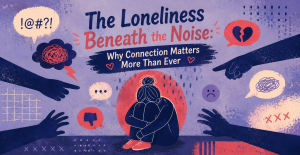
The Loneliness Beneath the Noise: Why Connection Matters More Than Ever
@Dr.Joan Neehall
FOR PSYCHOLOGISTS, THERAPISTS, AND HELPING PROFESSIONALS
The Person in Front of You
She smiles when she walks into your office.
She apologizes for being emotional.
She says:
“Other people have it worse.”
She is successful. Responsible. Capable.
Everyone depends on her.
And yet when you gently ask,
“When was the last time you felt truly cared for?”
she suddenly begins to cry.
Not because she is weak.
But because she cannot remember.
Many clients are not breaking down because they lack intelligence or coping skills.
They are breaking down because they have spent years carrying emotional pain silently while continuing to function for everyone else.
This June, many people entering therapy will not present as “falling apart.”
They will present as high functioning, overextended, emotionally exhausted human beings who have forgotten what it feels like to rest emotionally.
The Psychological Cost of Looking Fine
We now live in a culture where people are rewarded for appearing okay.
Clients often say:
- “I should be grateful.”
- “I have a good life.”
- “I don’t understand why I feel this way.”
And yet beneath the surface:
- their nervous systems are overwhelmed,
- their relationships feel emotionally distant,
- they are lonely in crowded rooms,
- and they cannot remember the last time they truly felt present.
Many are surviving rather than living.
The body often whispers before it screams:
- exhaustion,
- irritability,
- insomnia,
- numbness,
- overthinking,
- emotional shutdown,
- perfectionism,
- or chronic anxiety.
Not all suffering announces itself dramatically.
Sometimes suffering looks like competence.
Human Beings Heal in Connection
Research continues to show that emotional regulation does not happen in isolation. Daniel Siegel emphasizes the importance of attuned relationships in emotional integration, while Stephen Porges demonstrates how cues of safety directly affect the autonomic nervous system.
Sometimes what changes clients most profoundly is not a perfect intervention.
It is the experience of finally feeling:
- emotionally safe,
- seen without judgment,
- accepted without performance,
- and understood without having to explain everything.
Therapy can become the first place some people stop pretending.
And that moment matters.
A Reflection for Clinicians
Ask yourself:
- Which clients are quietly drowning while appearing successful?
- When have you mistaken functionality for wellness?
- How often do people minimize their suffering because they believe they “should” be stronger?
- What happens to people who spend years being needed but rarely emotionally held?
Sometimes the most healing moment in therapy is not insight.
It is relief.
Relief that someone finally sees the pain beneath the performance.
For Therapists Themselves
There is another truth we rarely say out loud:
Many therapists are tired too.
Not simply physically tired.
Emotionally tired.
Tired of holding pain.
Tired of being strong.
Tired of listening to trauma while privately trying to regulate their own nervous systems.
Therapists are often expected to endlessly give empathy while quietly suppressing their own humanity.
This month, pause and ask yourself:
- What restores me emotionally?
- Who allows me to exhale?
- Where do I feel emotionally safe?
- When did I last experience joy without guilt?
You are not only a clinician.
You are also a nervous system.
And nervous systems require care.
FOR THE GENERAL PUBLIC
“Why Am I So Tired All the Time?”
A woman recently said:
“I’m not even sure who I am anymore. I just keep going.”
Many people understand this feeling.
You wake up already tired.
You push through the day.
You answer texts.
Go to work.
Take care of others.
Smile when necessary.
And then late at night, when everything becomes quiet, a sadness appears you cannot fully explain.
Not because your life is terrible.
But because you have been emotionally disconnected from yourself for too long.
We Were Never Meant to Live This Way
Human beings were not designed for constant pressure, stimulation, comparison, and emotional suppression.
Yet many people spend years:
- rushing,
- multitasking,
- ignoring exhaustion,
- avoiding difficult emotions,
- and believing rest must be earned.
Over time, survival mode becomes normalized.
People begin forgetting:
- what calm feels like,
- what joy feels like,
- what emotional presence feels like.
And slowly, life becomes something to manage rather than experience.
The Small Moments That Bring Us Back
Healing is rarely one dramatic breakthrough.
More often, healing begins quietly.
A walk outside where you finally notice the sky.
A conversation where you feel understood.
A moment of laughter after months of heaviness.
Music that reaches something buried inside you.
Someone saying:
“You do not have to carry this alone.”
Research in positive psychology consistently shows that emotional well-being is strengthened through repeated moments of:
- connection,
- gratitude,
- kindness,
- movement,
- meaning,
- awe,
- and belonging.
The small moments matter more than we realize.
June Reflection Questions
Take a few quiet minutes this week and ask yourself:
- When was the last time I truly felt emotionally present?
- What am I carrying that no one sees?
- Who in my life makes me feel safe enough to be fully myself?
- What parts of me have I abandoned while trying to survive?
- What would healing look like if it did not require perfection?
Closing Thought
Some people are not looking for advice.
They are looking for permission:
- to slow down,
- to feel,
- to rest,
- to grieve,
- to reconnect,
- and to come back to themselves.
The healthiest people are not those who never struggle.
They are the people who learn how to return —
to connection,
to meaning,
to hope,
and to life itself.
As summer begins, perhaps the question is not:
“How much more can I accomplish?”
But instead:
“What would it feel like to truly come alive again?”
About Dr. Joan Neehall
https://ww.neehall.com
Board-certified clinical psychologist, founder, keynote speaker, TEDx speaker, Wall Street Journal bestselling author of Happy is the New Healthy and podcast host of Happiness on Demand .Dr. Neehall’s work focuses on emotional resilience, therapeutic connection, nervous system well-being, and the science of happiness. Her work with therapists centers on timing and how to land the right intervention and so enhance the therapeutic alliance .
For more information please email Joan@neehall.com
If you found this useful please share with others.